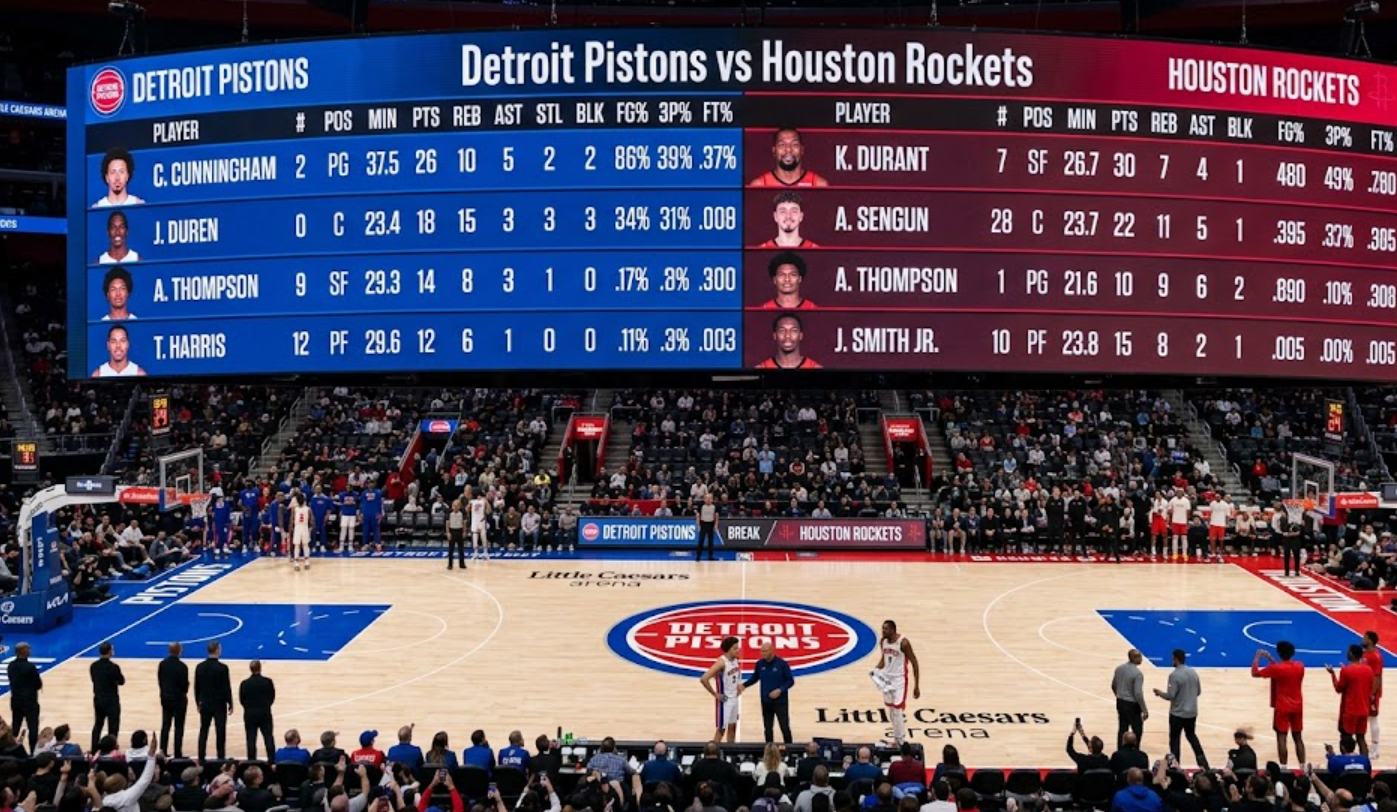
The detroit pistons vs houston rockets match player stats matter because they go beyond the final score and reveal how two young, developing NBA teams actually function on the court. Both franchises are in stages of rebuilding, which means their matchups are less about established dominance and more about evaluating growth, chemistry, and individual progress. Every game becomes a live case study of how rookies and emerging players respond under real competitive pressure.
What makes this matchup especially valuable is the contrast in playing styles. Houston typically leans into pace, spacing, and three-point volume, while Detroit often focuses on interior scoring, physical defense, and structured half-court sets. These differences create highly informative statistical outputs, where analysts can clearly see how different systems perform against each other. As a result, the stats from these games are widely used to track development trends, not just outcomes.
Team Performance Breakdown
Team performance in detroit pistons vs houston rockets match player stats often highlights a battle between pace and control. Houston usually generates more possessions due to their fast tempo, which leads to higher overall scoring opportunities but also increases variability. When their shooting is efficient, they can build strong leads quickly; when it is not, their defense is often tested in transition.
Detroit’s team performance, on the other hand, tends to revolve around limiting mistakes and maximizing half-court efficiency. They often rely on rebounding strength and paint scoring to stay competitive, even when perimeter shooting is inconsistent. This creates games where possession control and turnover management become the deciding factors rather than pure scoring output.
Key Player Stats – Detroit Pistons
Detroit Pistons player stats in this matchup usually reflect a young core still finding consistency in the NBA. Their leading scorers often produce solid point totals, but efficiency can vary depending on defensive pressure and shot selection. Guards typically carry high usage rates, while big men contribute heavily in rebounding and interior defense.
In many games, Pistons players show strong rebounding numbers and occasional defensive highlights, but turnovers can be an issue when facing Houston’s aggressive switching defense. This creates a statistical profile where individual talent is visible, but team cohesion is still developing, making their performance highly situational.
Key Player Stats – Houston Rockets
Houston Rockets player stats in detroit pistons vs houston rockets match player stats are often shaped by speed and perimeter-oriented offense. Multiple players typically score in double figures, reflecting a balanced offensive system rather than reliance on a single superstar. This distribution makes Houston harder to defend but also introduces fluctuations in efficiency.
Their guards and wings usually benefit the most, especially in transition situations where quick decisions lead to easy points. However, when three-point shooting is inconsistent, their offensive rhythm can suffer, leading to tighter games than expected. Still, their ability to generate volume shots keeps their statistical output consistently high.
Advanced Metrics and Emerging Trends
Advanced metrics provide deeper insight into detroit pistons vs houston rockets match player stats, especially when evaluating efficiency and impact beyond traditional box scores. Numbers like true shooting percentage, net rating, and assist-to-turnover ratio help explain which team is actually controlling the game flow rather than just scoring more points.
A key trend in this matchup is the importance of pace control. Houston’s high tempo increases statistical volume across the board, while Detroit’s slower pace emphasizes efficiency and defensive stability. These contrasting styles make advanced analytics essential for understanding the true balance of performance between the two teams.
Head-to-Head Insights
Head-to-head analysis of detroit pistons vs houston rockets match player stats shows that outcomes are often unpredictable and heavily influenced by in-game momentum shifts. Neither team has a long-standing dominance in recent years, which makes each matchup more dependent on execution than history.
Rebounding and turnover differential consistently emerge as the most important deciding factors. When Detroit controls the boards, they tend to slow Houston’s transition game effectively. Conversely, when Houston forces turnovers and speeds up possession count, they usually gain a clear advantage. This creates a matchup dynamic that swings based on energy and discipline.
Key Takeaways for Fans, Analysts, and Fantasy Players
For fans, these games are exciting because they showcase young talent with unpredictable outcomes. For analysts, they offer a valuable comparison of rebuilding strategies and playing styles. For fantasy basketball players, they provide opportunities for breakout performances due to inconsistent rotations and high usage variability.
The most important takeaway from detroit pistons vs houston rockets match player stats is that raw scoring alone does not tell the full story. Efficiency, pace control, and defensive execution play a much larger role in determining outcomes, especially in matchups between developing teams.
Conclusion and FAQs
The detroit pistons vs houston rockets match player stats highlight two teams still shaping their identities through youth development and evolving systems. Houston’s fast-paced, perimeter-heavy approach contrasts with Detroit’s structured, interior-focused strategy, creating games that are statistically rich and highly unpredictable. These matchups are best understood through both traditional and advanced metrics, which together reveal how each team is progressing over time.
FAQs
1. Why are Pistons vs Rockets stats important?
They show how two rebuilding teams develop strategies, players, and efficiency over time.
2. Which team plays faster?
Houston generally plays at a faster pace, increasing total possessions and scoring chances.
3. What stats decide the game most often?
Rebounds and turnovers are usually the biggest deciding factors.
4. Do individual players perform consistently in this matchup?
Not always—performance varies due to pace, defense, and young roster inconsistency.
Visit For More Information & Gossips:- About Mags